Why Is Costa Rica a Great Place to See Sloths?
Costa Rica’s tropical forests provide ideal habitats for sloths. They are mainly associated with humid, lowland forests on both the Pacific and Caribbean sides of the country.
Although a sighting is never guaranteed, exploring the rainforest with an experienced wildlife guide can greatly improve your chances of spotting an animal that may remain perfectly still among the leaves and branches.
More than simply finding a sloth, the experience gives travelers the opportunity to learn about one of Costa Rica’s most recognizable wildlife species.
The Two Sloth Species Found in Costa Rica
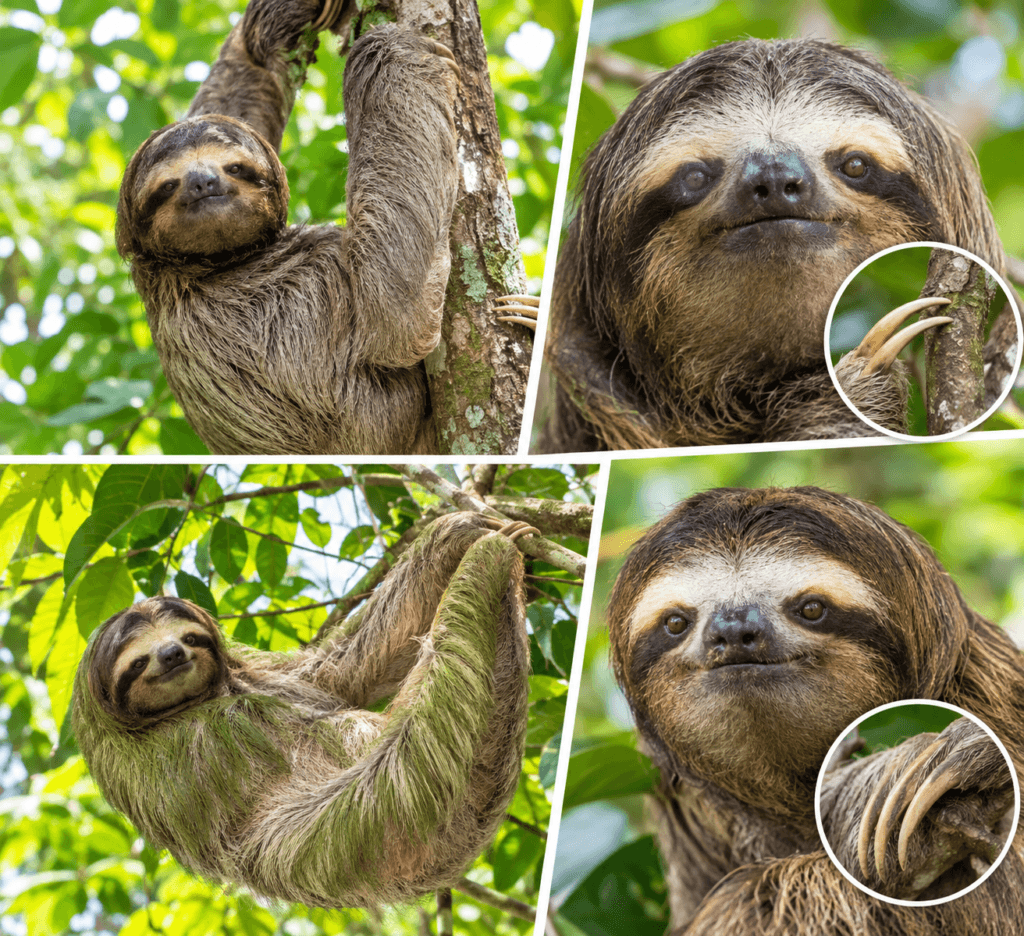
Before heading into the rainforest, it is worth learning about the two species found in Costa Rica. Knowing the differences can make your wildlife encounter even more interesting.
🦥 Brown-Throated Three-Toed Sloth
The brown-throated three-toed sloth (Bradypus variegatus) is probably the species most people picture when they think of a sloth.
It has three claws on its front and rear limbs, a distinctive dark facial pattern, and the characteristic expression often described as a smile. Unlike the two-toed sloth, it is mainly active during the daytime, making it more likely to be seen moving during daylight hours.
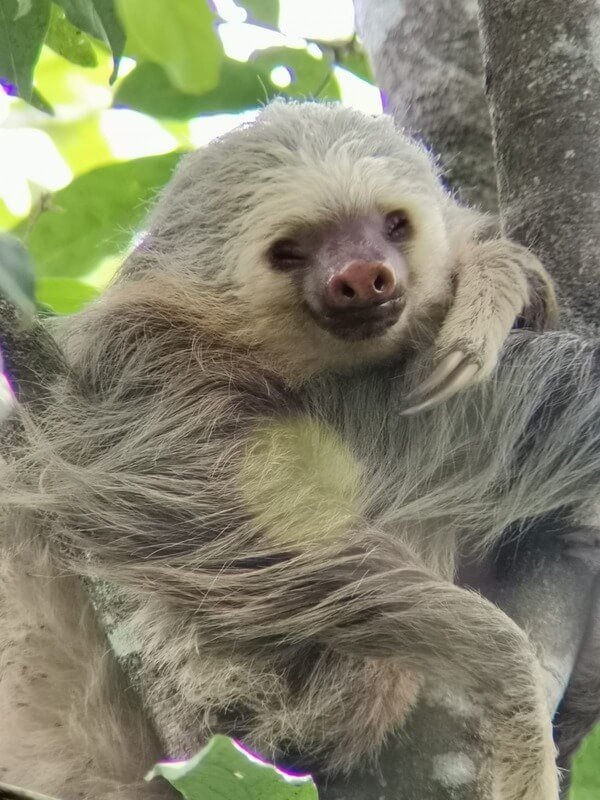
🦥 Hoffmann's Two-Toed Sloth
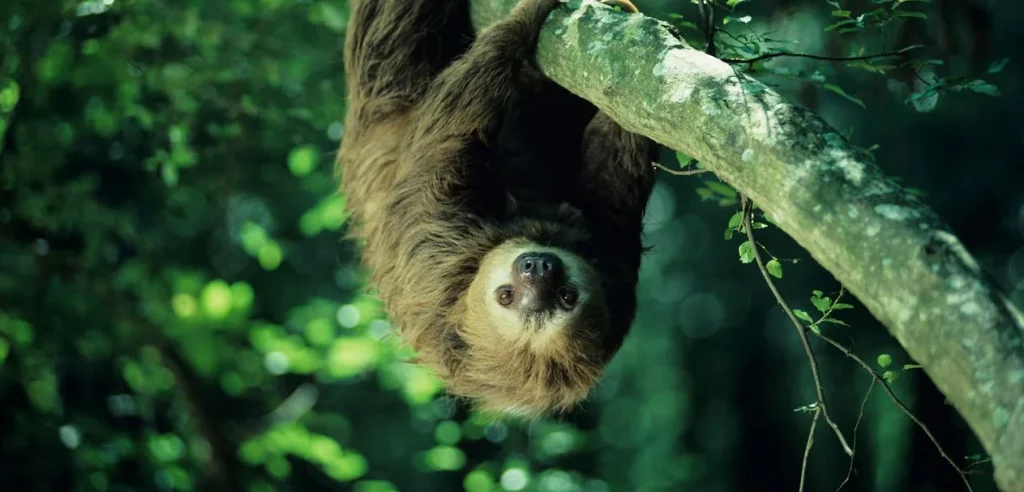
Hoffmann’s two-toed sloth (Choloepus hoffmanni) is larger and has longer, generally brown or golden-colored fur.
Its front limbs have two claws, which is one of the easiest ways to distinguish it from the three-toed species. It is also mainly nocturnal, so daytime sightings often involve a sloth resting high in the trees.
Where to See Sloths in Costa Rica
One of the great things about Costa Rica is that you do not have to visit just one destination to look for sloths. Several regions offer opportunities to spot them, each with its own landscapes and wildlife experiences.
Bijagua and Río Celeste
The Bijagua region, near Tenorio Volcano and Río Celeste, offers a more nature-focused experience with excellent opportunities for wildlife observation.
Both sloth species can be found in the area, while guided walks allow visitors to explore the rainforest and learn about the local flora and fauna. The proximity to Río Celeste also makes it possible to combine both experiences during the same trip.
Best for: nature lovers, photographers, and travelers interested in ecotourism.
La Fortuna and Arenal
La Fortuna is one of Costa Rica’s most popular destinations and an excellent choice for travelers interested in seeing sloths.
The surrounding tropical forests and private trails offer opportunities to spot sloths resting or moving slowly through the trees. You can also combine wildlife watching with other activities such as exploring the Arenal Volcano area, walking across hanging bridges, or relaxing in hot springs.
Best for: travelers looking to combine wildlife, adventure, and nature.
Cahuita and Puerto Viejo
Costa Rica’s Caribbean coast is another excellent region for sloth watching. The humid forests and tropical environment around Cahuita and Puerto Viejo provide suitable habitat for these animals.
Cahuita National Park is particularly attractive because its trails combine relatively easy hiking with coastal scenery and wildlife observation.
Best for: travelers looking for nature, beaches, and a different side of Costa Rica.
Manuel Antonio National Park
Manuel Antonio is one of Costa Rica’s best-known wildlife destinations and offers an excellent combination of rainforest, hiking trails, wildlife, and tropical beaches.
Sloths are among the animals that visitors may encounter in the park, along with monkeys, birds, and many other species.
Best for: travelers who want to combine sloth watching, beaches, and rainforest.
Osa Peninsula and Corcovado National Park
For travelers looking for an immersive rainforest experience, the Osa Peninsula offers one of Costa Rica’s most biodiverse environments.
Sloths may be part of the wildlife encounters, but the experience goes far beyond them. Visitors can encounter an impressive variety of mammals, birds, reptiles, and other species.
Best for: travelers passionate about biodiversity and wild nature.
Tortuguero
Tortuguero is famous for its canals, tropical forests, and extraordinary biodiversity. Boat tours provide a unique way to explore the ecosystem and look for wildlife among the vegetation.
Sloths are among the animals that may be spotted in the region, although the combination of canals, rainforest, and wildlife is what makes Tortuguero such a special destination.
Best for: travelers interested in nature, waterways, and wildlife observation.
🔭 How Can You Spot a Sloth in the Rainforest?
Finding a sloth can be more challenging than you might expect. Although these animals live throughout several regions of Costa Rica, their slow behavior and natural camouflage can make them surprisingly difficult to notice.
Look Up
One of the most common mistakes is looking only at eye level. Sloths spend much of their lives in trees, so carefully scanning the forest canopy is essential.
Look for Subtle Movement
Don’t expect to see an animal quickly moving between branches. Sloths move slowly and may remain still for long periods.
Learn Which Trees to Look For
Some tree species are particularly important to sloths. Experienced naturalist guides know which trees are commonly used and where animals are likely to be found, making sightings easier.
Bring Binoculars
Even when you successfully spot a sloth, it may be several meters above you. Binoculars allow you to observe the animal more clearly without getting too close.
What Is the Best Time to See Sloths?
Sloths can be found in Costa Rica throughout the year because they do not undertake seasonal migrations. However, the time of day can influence what you see.
Three-toed sloths are mainly active during daylight hours, particularly in the morning and late afternoon. Two-toed sloths are primarily nocturnal and often spend much of the day resting.
The dry season may sometimes make spotting wildlife easier because some trees lose part of their foliage, making animals easier to detect. During the green season, the forest canopy can be denser, but the rainforest itself becomes an especially vibrant environment for wildlife observation.
Is a Guided Sloth-Watching Tour Worth It?
Although you can occasionally spot sloths on your own, going with an experienced wildlife guide can make a significant difference.
Local guides know the area, recognize signs of wildlife activity, identify trees frequently used by sloths, and can notice movements that visitors might easily miss. They can also explain the animals’ behavior, diet, and characteristics.
For travelers whose main goal is to see sloths, a guided rainforest walk can be an excellent way to make the most of their time.
Tips for Photographing Sloths Responsibly
Seeing a sloth in the wild can become one of the most memorable moments of your Costa Rica vacation. However, it is important to observe the animal without disturbing its natural behavior.
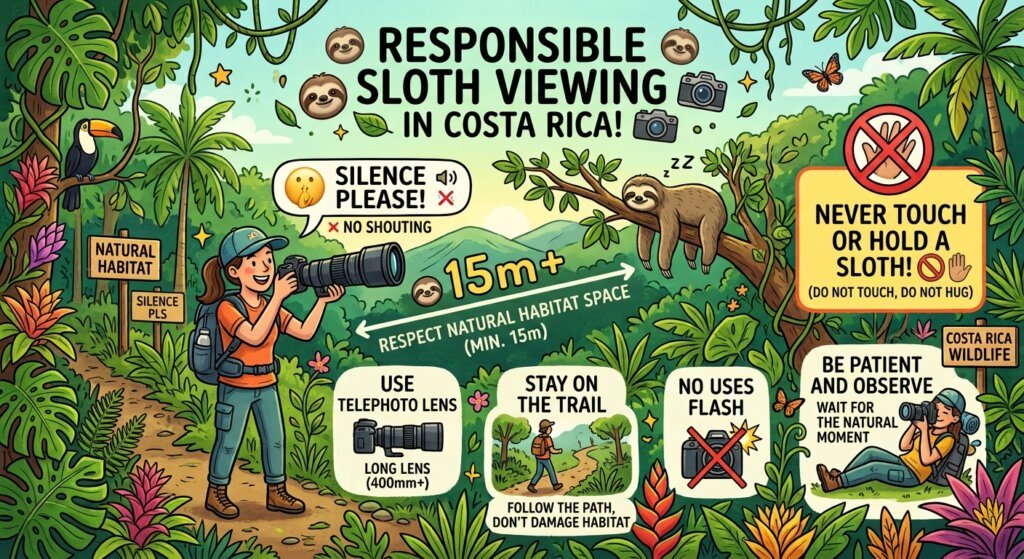
📷 Use a zoom lens or telephoto lens instead of getting too close.
🤫 Keep noise to a minimum.
🌿 Never touch, feed, or attempt to move a sloth.
🚫 Never hold a sloth for a photograph.
👥 Respect the space of other visitors and avoid crowding the animal.
Responsible wildlife watching helps protect animals and ensures that future visitors can enjoy similar encounters.
Wild Sloths vs. Rescue Centers: What's the Difference?
Seeing a sloth in the wild and visiting a rescue center are two different experiences.
Rescue centers and sanctuaries may care for injured, orphaned, or non-releasable animals. A wild encounter, on the other hand, allows you to observe a sloth in its natural ecosystem without human intervention.
If your goal is to understand the natural behavior of these animals, seeing a sloth in its own habitat can be an especially rewarding experience.
Responsible Tourism: Enjoy Sloths Without Disturbing Them
Respect for wildlife should be an essential part of every nature experience in Costa Rica.
Sloths are wild animals and should always be observed from an appropriate distance. They should never be touched, fed, or handled for photographs.
A truly meaningful wildlife encounter is not about getting as close as possible. It is about watching an animal behave naturally in the environment where it belongs.
A Wildlife Experience to Remember
Watching a sloth peacefully resting among the branches may seem like a simple encounter, but it is an opportunity to connect with Costa Rica’s remarkable biodiversity.
From La Fortuna and Arenal to Manuel Antonio, Cahuita, Tortuguero, Bijagua, and the Osa Peninsula, travelers have several opportunities to search for these fascinating animals.
Plan your route, bring your binoculars, be patient, and most importantly, enjoy the experience while respecting the natural environment. Costa Rica is not only a destination to visit; it is a place to observe, listen, and discover. 🦥🌿